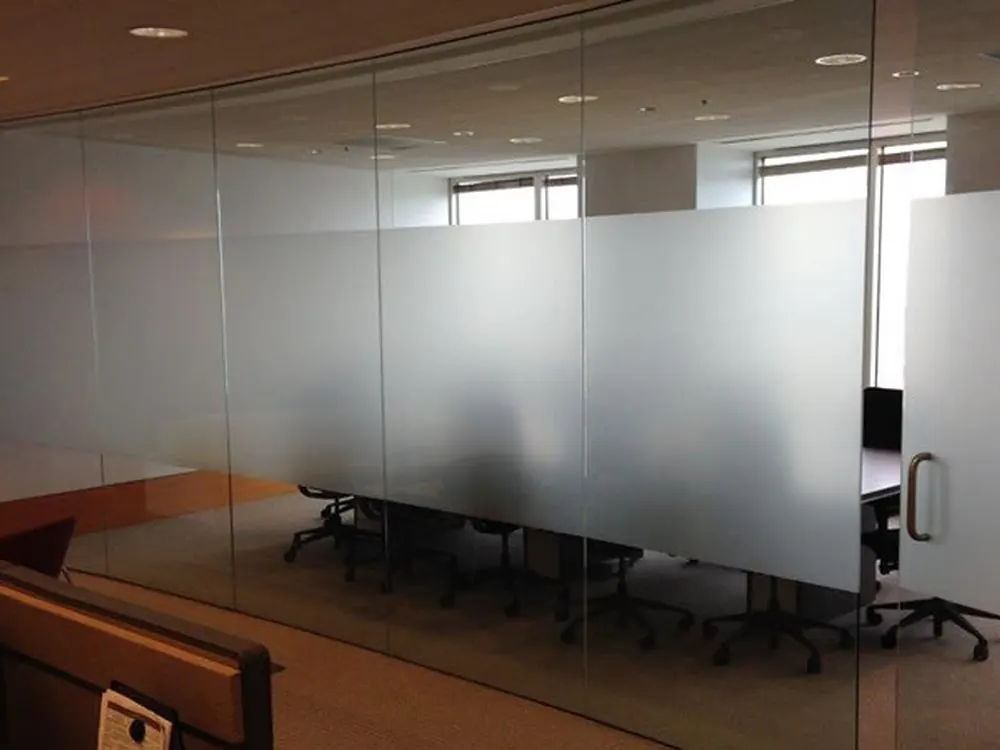
The most common thing we hear on a security walkthrough is that the house already has tempered glass. It's a reasonable thing to believe and it's protection against the wrong problem. Tempered glass is engineered to break safely. Security film is engineered not to break open. Those are very different jobs.
What tempered glass is actually for
Tempered glass is heat-treated so that when it fails it shatters into small blunt granules rather than long blades. That's a genuine safety improvement and it's why code requires it in doors, sidelights, tub enclosures, and low glazing. Nobody should skip it.
But look carefully at what that describes. It says nothing about resisting an impact — it describes what happens after the impact succeeds. A tempered pane struck hard enough disintegrates completely and instantly, leaving a wide open frame. For someone trying to get in, that's arguably a better outcome than annealed glass, which leaves jagged pieces in the way.
What security film does instead
Security film is a thick, optically clear polyester laminate bonded to the interior face. When the pane is struck it still breaks — film doesn't make glass unbreakable, and anyone claiming otherwise is selling something — but the fragments stay bonded to the laminate. Instead of an opening you get a cracked, sagging, still-in-place sheet.
The security value is entirely in the time that creates. An entry planned to take three seconds now takes repeated loud swings at a pane that keeps refusing to open. In a tract neighbourhood where houses are close together, that noise is the actual deterrent. That's the whole proposition of residential security film: delay and noise, not invincibility.

Why the frame attachment matters more than the film
Here's the detail that separates a real security installation from a nominal one. If film is applied only to the visible glass, a determined attacker can eventually push the whole filmed pane out of the frame in one piece. The film held the glass together and then the glass left the building.
The fix is a structural attachment system — either a wet-glaze sealant bead or a mechanical batten — bonding the film's edge to the window frame itself. Now the pane can't be pushed out, and you get the full delay the film is capable of.
- Daylight applied — the film finishes at the visible edge. Fine for holding shards, weakest under attack.
- Edge-to-edge — the film carries under the glazing bead and has more to grip.
- Wet-glazed — a structural silicone bead bonds film to frame. The standard for real security work.
- Mechanically attached — an aluminium batten clamps the system down, used where blast is the concern.
This is the line to hold two bids against each other on. The same stated thickness can mean two completely different installations.
The case for doing both
None of this argues against tempered glass. Keep it where code requires it — it is genuinely safer in an accident. Then add film on top for the openings that matter: the patio slider, ground-floor rear windows, and anything screened from the street by a block wall or landscaping.
Film on tempered glass is a completely standard combination and it's what most of our residential work here looks like. You get safe failure behaviour and forced-entry delay from the same pane.
Scope it narrowly
For most homes here the honest scope is smaller than what tends to get quoted. Front elevations are highly visible from the street and rarely the point of entry; the money belongs on the rear and side glass that nobody can see.
If you'd like a straight assessment of which openings are genuinely exposed — including the ones we'd tell you to leave alone — book a walkthrough. No charge, and no pressure either way.